March 2023
I contributed my chapter “Accommodating Incomplete DDR, Security Sector Development, and Veterans’ Issues to Peacebuilding Efforts: National Responses, Suco, and Local Security in Timor-Leste”
“Innovation in Peacebuilding Research:Bridging SDGs 16 and the View of Field”
This project explored how SDGs 16 “Peace, Justice, and strong Institutions” could be achieved by linking the goal with other SDGs. By inviting specialists in the respective fields, it considered peacebuilding issues from perspectives of information technology, urban development, environmental management, gender, corporate social responsibility, and elections. The project conducted two seminars (one co-hosted with ORIS, Waseda University and one hosted by Aoyama Gakuin University).
The project found the collaboration among private companies, governments and academics have strong potentials for achieving SDGs16. At the same time, applying SDGs could reveal new tensions from such interactions.
The report (in Japanese) is available at the following site: https://ac.cdn-aoyamagakuin.com/wp-content/uploads/2020/10/rs_200325_peacebuilding_report.pdf
During this project, my colleague, Takashi Nagatsuji has presented our preliminary findings on ongoing project (co-authored with Rui Asano), regarding the long-term impacts of wartime violent events on voting behavior in the post-conflict 2017 Liberian elections.
I also conducted a project of the long-term impact of Disarmament, Demobilization, and Reintegration (DDR) in Liberia, supported by Center for International Studies at Aoyama Gakuin University. This project conducted interviews to ex-commanders, ex-combatants and relevant stakeholders to explore their experiences throughout the wartime and post-war period.
A ‘Local’ Response to Peacebuilding Efforts in Timor-Leste
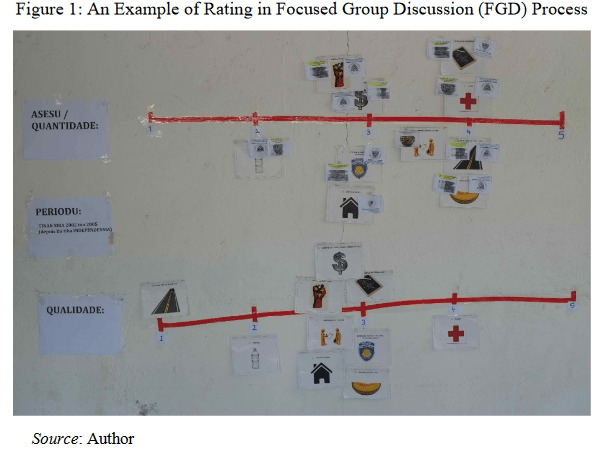
This paper unpacks the voice of ‘the local’ to understand the mechanisms of peacebuilding together with development. By conducting focused group discussions (FGD) in three villages in Timor-Leste and utilizing a community-based rating system for ten key areas, we found that external efforts are perceived differently with respect to location and time.
 Yukako Tanaka-Sakabe